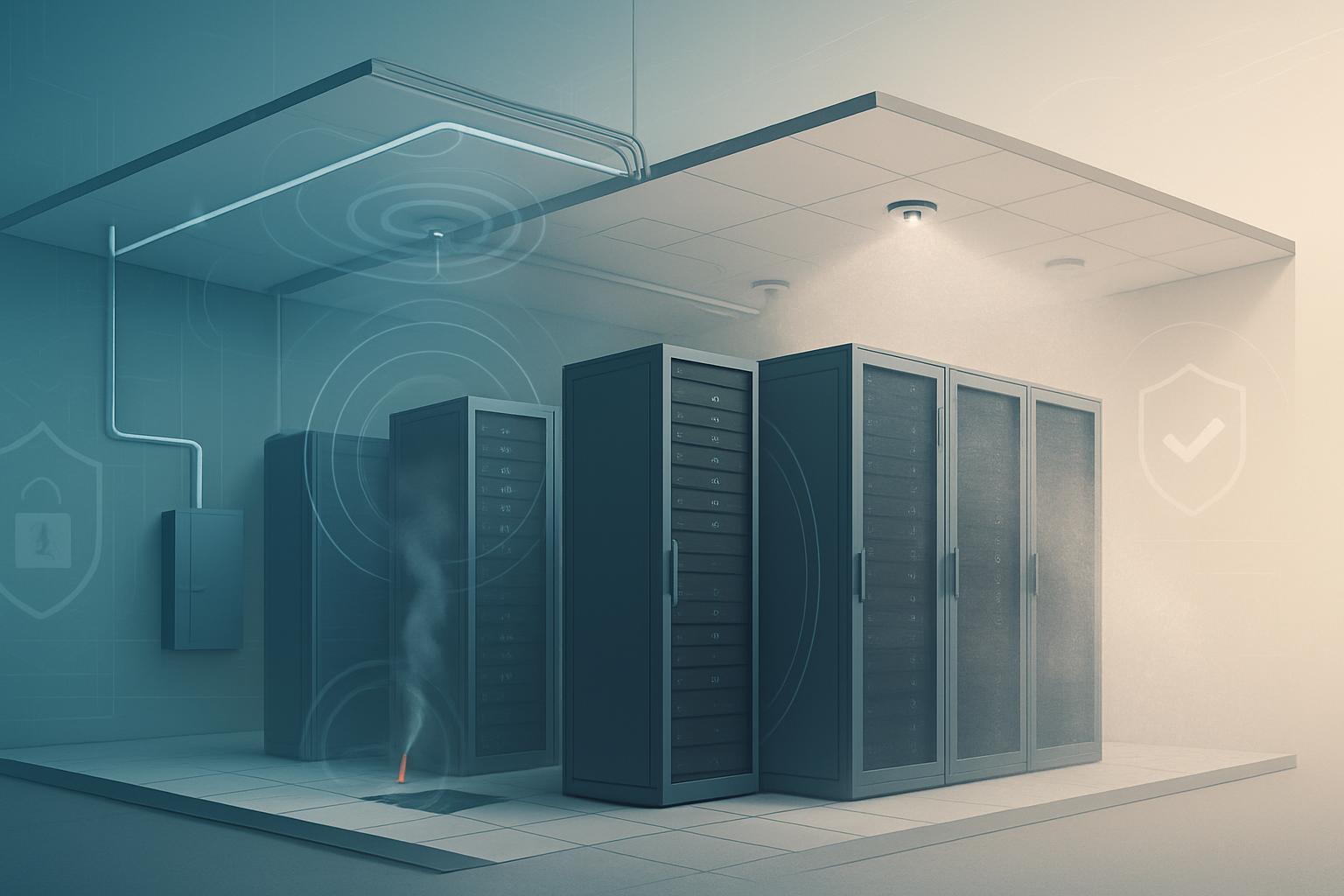
Fire suppression vs fire detection server room controls are complementary: detection identifies smoke, heat, or combustion products and triggers alarms, while suppression releases an agent or water system to control or extinguish the fire. A server room needs both because an alarm alone does not stop a fire, and a suppression system cannot protect equipment effectively if it is not triggered promptly, maintained, and integrated with life-safety procedures. For ISO 27001 Annex A control 7.5, auditors will expect evidence that the combined design protects infrastructure from fire as a physical and environmental threat.
What is fire detection in a server room?
Fire detection is the capability to identify signs of fire early and communicate that condition to people and systems that must respond. Detection equipment does not put out a fire. Its purpose is to provide the earliest practical warning, initiate emergency actions, and—where designed—start the sequence that can release a suppression agent.
In a server room, detection commonly includes photoelectric smoke detectors, heat detectors, very early warning aspirating smoke detection, manual pull stations, and a monitored fire alarm control panel. A well-designed installation may use an aspirating system such as VESDA-E VEP to sample air from above the racks, below a raised floor, and near return-air paths. This type of system can identify very low levels of smoke before a conventional ceiling detector enters alarm.
For example, an IT manager may configure an early-warning smoke condition to create an alert in the building monitoring system and open an incident ticket. A higher confirmed-alarm condition may activate audible and visual alarms, notify the monitoring provider, shut down affected HVAC equipment, and begin a pre-discharge countdown for the clean-agent system. Those actions are detection and alarm functions, even when they lead to suppression.
What is fire suppression in a server room?
Fire suppression is the capability to control, contain, or extinguish a fire after detection or manual activation. It involves a fire-extinguishing agent, a distribution system, release controls, and engineering features that allow the agent to work as intended. In server rooms, the most common options are clean-agent systems, pre-action sprinklers, and portable extinguishers appropriate to the hazard.
A clean-agent system might use FK-5-1-12 agent, commonly known by the former Novec 1230 designation, or an inert gas system such as IG-541. When a confirmed alarm occurs, the release panel opens cylinders or valves and sends agent through piping and nozzles into the protected room. The objective is generally to reduce combustion without applying water directly to operating IT equipment.
For example, a 45-second pre-discharge delay may allow occupants to exit after audible warnings begin. The system may then release FK-5-1-12 into a sealed server room, close fire dampers, stop supply-air fans, and maintain agent concentration long enough to suppress the fire. The clean agent is the suppression control; the detectors, release logic, alarms, and shutdown signals enable it to operate safely and reliably.
How does fire suppression vs fire detection server room protection compare?
| Comparison point | Fire detection | Fire suppression |
|---|---|---|
| Primary purpose | Identify smoke, heat, flame, or combustion products and raise an alarm. | Control or extinguish fire by releasing an extinguishing agent or applying water. |
| Typical server-room components | VESDA-E aspirating detector, photoelectric smoke detector, heat detector, manual pull station, Notifier NFS2-3030 panel. | FK-5-1-12 or IG-541 cylinders, release panel, piping, nozzles, pre-action sprinkler valve, portable Class C extinguisher. |
| What it does during an event | Alerts occupants, signals a monitoring service, initiates incident response, and can start release logic. | Discharges agent or water after approved release conditions are met to reduce fire intensity or extinguish it. |
| Typical activation setting | Early-warning smoke alarm at a low obscuration threshold; confirmed alarm after a second detector zone activates. | Automatic release after two independent detector zones confirm alarm and a 30–60 second evacuation delay expires. |
| Key maintenance evidence | Detector inspection records, sensitivity testing, alarm test logs, monitoring certificates, fault-response tickets. | Cylinder pressure or weight records, annual inspection reports, enclosure-integrity test results, discharge circuit tests, impairment logs. |
| Failure consequence | Delayed awareness and delayed intervention; suppression may not release automatically. | Fire may continue despite prompt alarm, increasing downtime, equipment loss, and recovery costs. |
| What it does not replace | It does not extinguish a fire or protect equipment from heat and soot damage. | It does not provide early warning, safe evacuation notification, or reliable event identification by itself. |
Where do organizations confuse detection and suppression under ISO 27001 control 7.5?
The most common confusion is treating a building fire alarm as proof that the server room has fire protection. A monitored smoke detector can satisfy part of the detection need, but it does not demonstrate that the organization has designed adequate protection for a high-value room containing concentrated infrastructure. Conversely, an organization may point to clean-agent cylinders in the room without proving that the detection, release logic, enclosure, and maintenance arrangements will allow those cylinders to work.
ISO 27001 Annex A 7.5 requires protection against physical and environmental threats to be designed and implemented. For an audit, this means the evidence should show a deliberate risk-based decision rather than an assumption that whatever was installed by the building owner is sufficient. The design decision should consider the room’s equipment value, service criticality, occupancy, electrical load, fire load, proximity to water pipes, building fire strategy, and the time required to restore services after an incident.
An assessor is likely to distinguish between the following claims:
- “The building has smoke alarms.” This supports detection, but the auditor may ask whether detection covers the server room, underfloor void, ceiling void, and HVAC airflow paths.
- “The room has a clean-agent system.” This supports suppression, but the auditor may ask for the release logic, inspection certificate, agent quantity calculation, and enclosure-integrity or room-integrity test result.
- “Our facilities provider handles it.” Outsourcing maintenance does not remove accountability. The organization should retain service reports, escalation arrangements, impairment notifications, and proof that defects are tracked to closure.
- “The system is connected to the fire panel.” Integration is useful, but the audit question is whether the configured sequence is appropriate. A release should not occur from a single unreliable signal if the approved design requires cross-zoned detection or manual confirmation.
For a certification audit, be prepared to show the connection between the risk assessment and the selected controls. If the risk treatment plan identifies fire as a threat to on-premises infrastructure, the record should explain why the organization selected conventional smoke detection, aspirating detection, clean agent, pre-action sprinklers, or a combination. It should also identify who approves temporary impairments, such as a disabled detector loop or a suppression cylinder removed for servicing.
What evidence should an IT manager have ready for the assessor?
You do not need to present a generic facilities binder without context. Instead, organize evidence around whether the protection works as designed. Keep the current server-room floor plan showing detector locations, agent nozzles, manual release and abort stations, and protected boundaries. Retain the approved fire-protection design or facilities specification, the latest maintenance and inspection reports, and records of any remedial work.
Also ensure your operational records distinguish alarm testing from agent discharge testing. A quarterly functional test of detector inputs and alarm outputs is not evidence that cylinder pressure, nozzle condition, room sealing, or hold time remain adequate. For clean-agent protection, an enclosure-integrity test is especially important because open cable penetrations, unsealed conduits, and poorly fitted doors can prevent the required agent concentration from being maintained.
Detection and suppression must also be reflected in continuity planning. If alarms trigger an automatic shutdown of HVAC or electrical equipment, the server-room emergency procedure should state who validates the condition, who contacts facilities and the monitoring provider, who decides whether to fail over workloads, and how the room is returned to service after fire authorities permit re-entry. This gives the assessor evidence that the physical control supports availability rather than creating unmanaged operational risk.
What is the verdict for fire detection and suppression?
The verdict is that detection and suppression are not alternatives: fire detection provides early warning and initiates the response, while fire suppression limits the damage once a fire is confirmed. For a server room governed by ISO 27001 Annex A 7.5, the defensible position is to use detection appropriate to the room’s fire risk and pair it with suppression or another documented fire-control measure appropriate to the business impact, building design, and legal fire-safety requirements.
Before your audit, ask facilities for the current detection-and-suppression design records, maintenance evidence, and impairment history, then map each item to your ISO 27001 Annex A 7.5 risk treatment.


