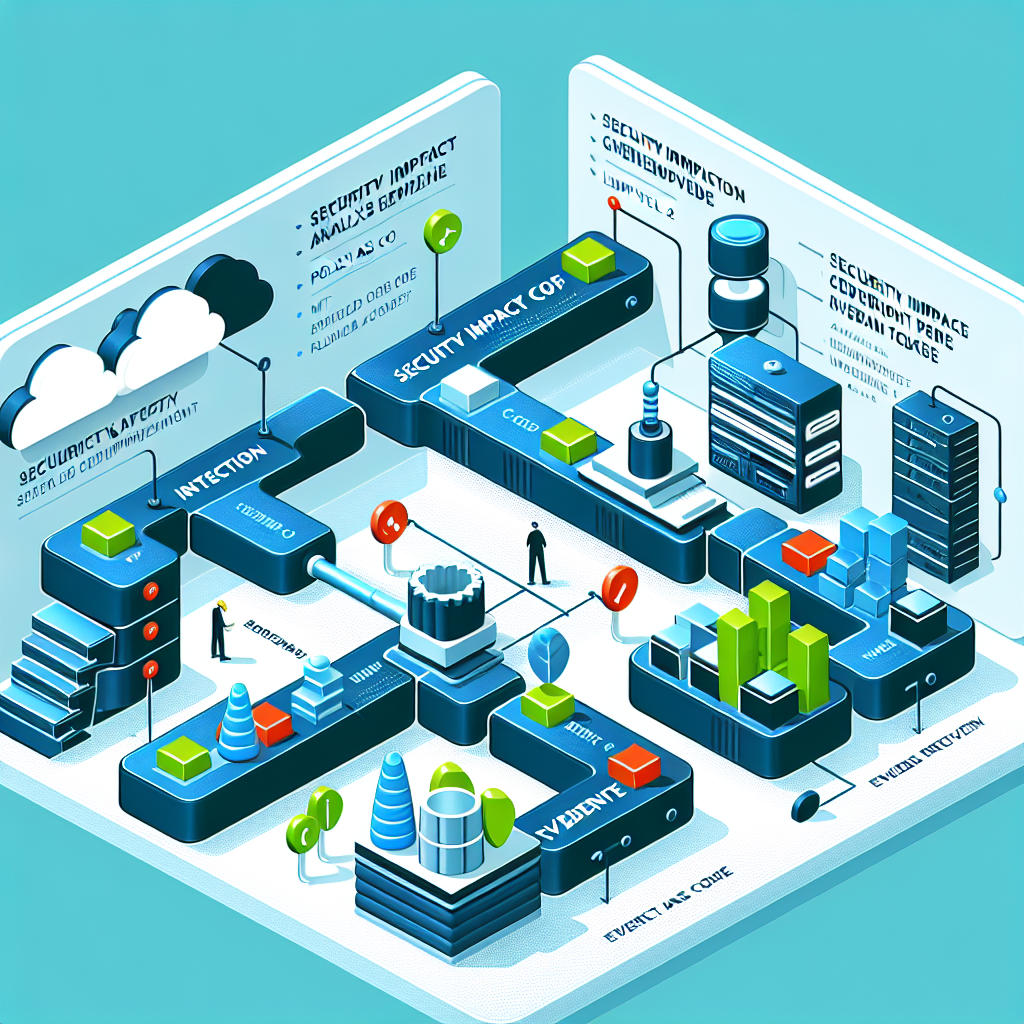
Security Impact Analysis (SIA) under CM.L2-3.4.4 requires organizations to analyze changes to system components (software, configurations, infrastructure) for potential security impacts before those changes are accepted and implemented. For DevOps teams this means turning manual change reviews into automated, repeatable pipeline checks that generate audit-ready evidence while preserving fast delivery cadence.
What CM.L2-3.4.4 means for DevOps
At its core CM.L2-3.4.4 requires that changes are evaluated for security consequences — not just functional outcomes. In a DevOps context you must instrument your CI/CD and infrastructure-as-code (IaC) workflows so each change is analyzed for risks (vulnerabilities, insecure configuration, dependency issues, compliance drift) and either blocked or routed for additional review. For small businesses this should be lightweight, automated, and integrated with PR gating, ticketing, and artifact storage so auditors can validate that every change had a documented SIA prior to deployment.
Where to integrate Security Impact Analysis into pipelines
Insert SIA checks at these points in your workflow: repository push/PR (pre-merge), build stage (artifact creation), pre-deploy (staging gate or canary), and in post-deploy monitoring (to capture runtime impacts). Typical pipeline stages look like: pre-commit/pre-receive hooks → PR SIA checks (SAST/IaC/Dependency/SBOM/Policy-as-code) → required approvals (manual when needed) → gated deploy to staging/canary → runtime verification and automated rollback if a new risk appears.
Policy-as-code and gating (Practical)
Define what constitutes a significant security impact as code. Use Open Policy Agent (OPA)/Conftest/Rego or Gatekeeper to codify rules such as "no plaintext secrets in IaC", "no IAM role with wildcard actions", or "approved base image list only." Enforce these rules as a required PR check that returns a machine-readable report (JSON) stored as pipeline artifact. This gives you deterministic, auditable “pass/fail” decisions aligned to CM.L2-3.4.4.
Automated static/dynamic analysis and SBOMs (Technical)
Combine complimentary automated checks so SIA is comprehensive and fast. At minimum include IaC scanning, SAST, dependency scanning (SCA), image scanning and generation of an SBOM. Example lightweight GitHub Actions job steps (adapt for GitLab/Jenkins):
# Example GitHub Actions snippet (conceptual)
- name: Checkout
  uses: actions/checkout@v3

- name: IaC scan (tfsec / checkov)
  run: |
    tfsec .
    checkov -d .

- name: Container image scan & SBOM
  run: |
    docker build -t myapp:$ .
    trivy image --scanners vuln,config myapp:$
    syft package:myapp:$ -o cyclonedx > sbom-$.json

- name: Policy check (conftest)
  run: conftest test deployment.yaml --policy ./policy
Store trivy/scan outputs and SBOMs as pipeline artifacts and link them to the PR. If any high-severity findings appear, the pipeline should fail the merge and create a ticket automatically (via API) that captures the SIA output.
Manual review, threat modeling, and runtime validation
Not every change can be fully automated; define thresholds that require human-in-the-loop review (e.g., changes to auth, network rules, or lateral access). Integrate short, structured threat-model templates into PRs that must be completed when a change modifies critical components. Combine this with runtime verification: e.g., automated canary traffic tests, runtime policy enforcement (Falco/Datadog/Security Agent), and automated rollback on anomalous signals. Record logs and timeline correlations to demonstrate the analysis was performed and followed by remediation or acceptance.
Practical implementation checklist for a small business
Follow this prioritized checklist to meet CM.L2-3.4.4 without heavy investment:
- Define change-impact thresholds and map them to pipeline gates (policy-as-code).
- Add IaC scanning (tfsec/checkov), SAST (semgrep/bandit), and SCA (trivy/grype) to PR checks.
- Generate and store SBOMs for builds (syft/cyclonedx) as pipeline artifacts.
- Automate ticket creation for failed SIA results and require closure before merge.
- Configure mandatory PR templates that include a brief threat-model checklist for high-impact changes.
- Keep immutable pipeline logs, archived SIA reports, and PR approval records for audit evidence (retain per your records schedule).
Real-world small-business scenario
Example: A 25-person software company hosts services in AWS and uses GitHub + GitHub Actions + Terraform. They implement:
- Pre-merge GitHub Actions job that runs tfsec, checkov, semgrep, and trivy; failures block merging.
- Conftest rules that prevent unchecked IAM wildcard policies and disallow storing plaintext secrets in repos.
- SBOM generated on build with syft and stored in S3 with pipeline metadata for each commit SHA.
- Automation that opens a Jira ticket on high severity findings, attaching the scan reports and referencing the PR.
- Periodic (quarterly) tabletop reviews of change impacts and a monthly report to the compliance owner with evidence links.
Risks of not implementing CM.L2-3.4.4
Failing to perform Security Impact Analysis increases the risk of introducing new vulnerabilities, misconfigurations, privilege escalation paths, or supply-chain problems. For contractors handling Controlled Unclassified Information (CUI) — the audience for NIST SP 800-171/CMMC — noncompliance can lead to contract loss, remediation costs, data breaches, regulatory penalties, and reputational damage. Operationally, lack of SIA leads to firefighting, longer incident response times, and poor audit outcomes because there is no proof changes were evaluated before deployment.
Compliance tips and best practices
Key tips:
- Treat SIA artifacts as first-class evidence: keep scan outputs, SBOMs, PR approvals, and ticket links immutable and queryable for audits.
- Start with blocking high-risk classes (secrets, IAM, network changes) and iterate to cover more areas.
- Use thresholds to avoid overblocking (e.g., allow low-severity findings with documented compensating controls).
- Train developers on reading SIA outputs and remediating findings — automation reduces work but developer knowledge shortens turnaround.
- Review your policies and tooling quarterly to keep up with new threats and tool updates.
In summary, integrating Security Impact Analysis into DevOps pipelines for NIST SP 800-171 Rev.2 / CMMC 2.0 Level 2 Control CM.L2-3.4.4 is achievable by codifying impact rules, automating complementary scans (IaC, SAST, SCA, SBOM), gating merges, adding lightweight manual review for high-impact changes, and preserving all artifacts for audit evidence. For small businesses, prioritize high-risk checks, use open-source tools to control costs, and automate ticketing and evidence collection so compliance becomes a natural part of your delivery lifecycle rather than a last-minute chore.


