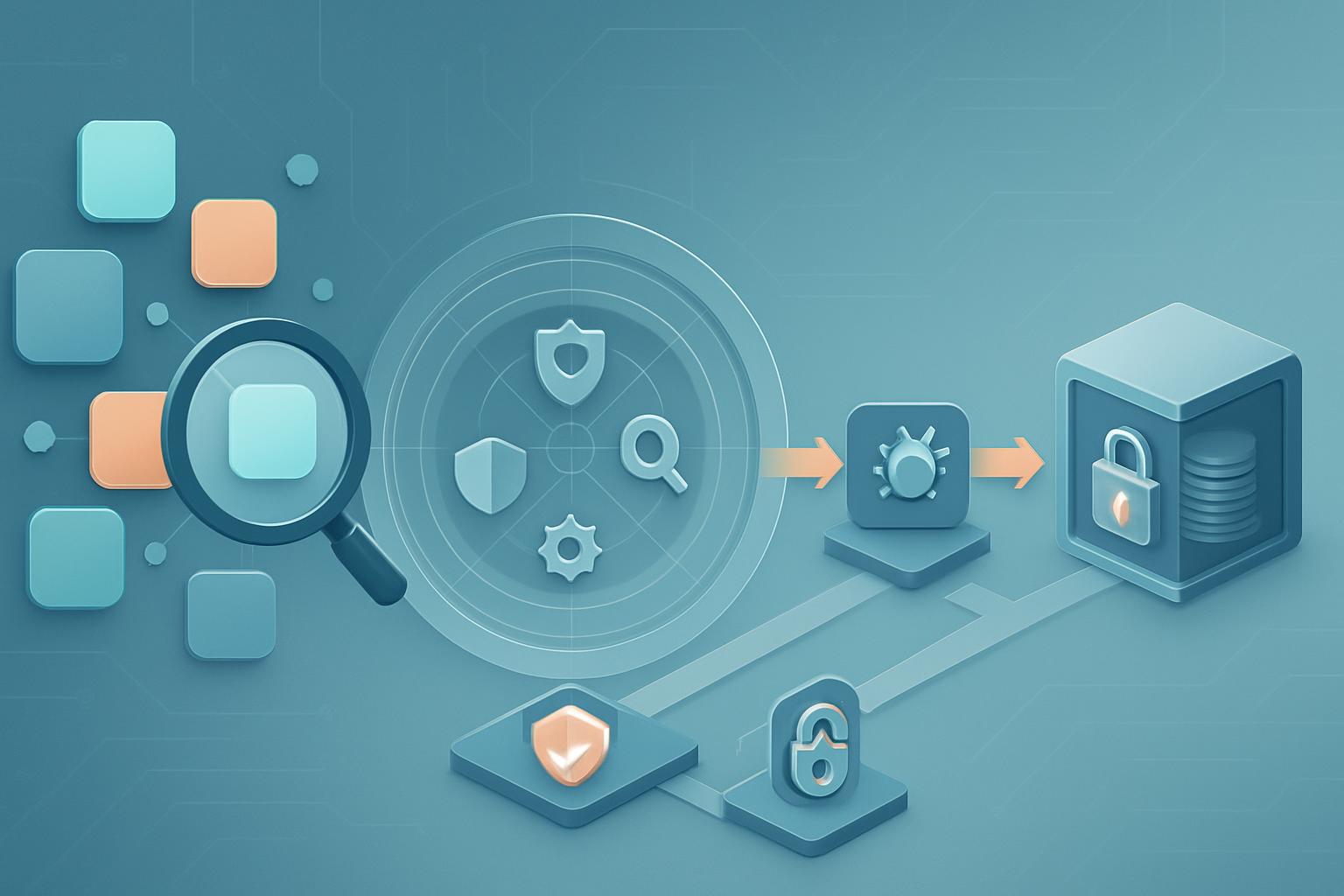
A 30 day plan for application security requirements should first identify every active application and its security gaps, then establish an approved requirements baseline, apply minimum controls to current projects, test releases, and retain evidence for Essential Cybersecurity Controls (ECC – 2 : 2024) Practice 1-6-3. For a sole IT administrator, the practical goal is not building a perfect secure-development program in one month; it is creating a repeatable, approved release gate that covers secure coding, trusted tools, security testing, secure integration, and pre-production hardening.
What should you assess before changing application security requirements?
Start with a current-state assessment during Days 1 through 5. Your first task is to establish scope, because “application development” may include internally built web applications, low-code workflows, vendor-customized systems, APIs, scripts, mobile applications, and infrastructure images used to deploy them. Do not assume that a vendor-hosted application is out of scope if your team develops integrations, manages configuration, or deploys custom code.
Create one application inventory that is useful both operationally and as evidence. A spreadsheet is acceptable initially if it is controlled, versioned, and assigned an owner. Include applications already in production as well as projects currently being developed or changed.
| Inventory field | Example value | Why it matters for ECC 1-6-3 |
|---|---|---|
| Application name | Supplier Portal | Links testing, approvals, and release evidence to a named asset. |
| Business owner | Procurement Manager | Identifies the representative who can approve requirements and risk decisions. |
| Technology and repository | Node.js 20, GitHub Enterprise | Determines coding standards, dependency controls, and source ownership. |
| Integration points | Microsoft Entra ID, SAP API, payment gateway | Defines the scope for API and system integration testing. |
| Data classification | Confidential supplier records | Helps prioritize authentication, encryption, logging, and access controls. |
| Release method | Azure DevOps pipeline to Azure App Service | Shows where to place configuration, patching, and approval gates. |
| Current security evidence | None; informal developer checks only | Records the gap without trying to recreate unsupported evidence. |
For each application, mark the five ECC 1-6-3 objectives as green, amber, or red. A red rating means there is no evidence or no repeatable process. For example, a project may be amber for trusted libraries if developers use npm but no one reviews dependency licenses or sources. It may be red for secure integration if APIs have never been tested for broken authorization, weak authentication, or insecure transport.
Keep this assessment short. As the person doing security alongside daily IT work, you need a defensible baseline by Day 5, not a six-week discovery project. Prioritize internet-facing applications, systems handling confidential data, and integrations that can create or modify business records.
What does a compliant target state for ECC 1-6-3 look like?
Your target state is a small operating model that makes security requirements visible before development and verifiable before release. ECC Practice 1-6-3 requires documented cybersecurity requirements approved by the appropriate representative, along with evidence that the requirements are implemented. Build one master document called Application Security Requirements and Release Procedure, then attach application-specific records to it.
The procedure should assign clear responsibilities. You may be the security reviewer and release coordinator, but you should not silently become the business risk owner. The application owner approves requirements and accepts any approved exception; a developer or supplier remediates findings; and the IT administrator verifies the evidence before production deployment.
- Secure coding standard: Adopt a concise baseline based on OWASP ASVS, OWASP Top 10, and language-specific guidance. Require code review, input validation, parameterized queries, secrets management, error handling, authentication, authorization, and logging appropriate to the application.
- Trusted and licensed tools: Maintain an approved development-tool and library register. Permit only supported package registries, such as npmjs.com, PyPI, Maven Central, NuGet.org, or vendor repositories, with documented license review for production dependencies.
- Security compliance testing: Require source-code scanning, dependency scanning, authentication and access-management checks, and proportionate vulnerability or penetration testing before release.
- Secure integration: Require System Integration Testing (SIT) and API testing for every new or changed integration. Test authorization, token validation, transport encryption, input validation, error handling, rate limits, and audit logs.
- Secure configuration, hardening, and patching: Require a pre-go-live configuration review, an approved baseline image or configuration template, patch verification, and periodic review after release.
For a small environment, standardize on tools you can operate. GitHub Advanced Security or GitLab Ultimate can provide code and dependency scanning; OWASP ZAP can perform baseline web scans; Postman or Newman can run API tests; and Microsoft Defender for Cloud, Azure Policy, or CIS benchmarks can support configuration review. Choose tools already licensed where possible rather than creating an unmanageable tool stack.
What is the 30 day plan for application security requirements?
The migration below uses five phases. Each phase has a milestone that creates evidence for the next phase, reducing the chance that you end the month with a policy but no proof of implementation.
| Phase and days | Actions | Milestone | Evidence retained |
|---|---|---|---|
| 1. Discover and triage Days 1–5 |
Build the application inventory; identify owners, repositories, integrations, deployment paths, and current release practices; rate the five ECC objectives. | Scope and highest-risk applications agreed. | Application inventory, gap register, owner confirmation emails or meeting record. |
| 2. Define the baseline Days 6–10 |
Write the Application Security Requirements and Release Procedure; define severity thresholds; create exception and approval forms; obtain representative approval. | Approved security requirements document. | Approved policy or procedure, version history, approval record. |
| 3. Control the supply chain Days 11–16 |
Create approved tool and library register; enable dependency scanning; block unapproved repositories; document licenses for production libraries. | All active projects have a known dependency source. | Tool/library register, software bill of materials, scanner reports, license review records. |
| 4. Build release gates Days 17–24 |
Add code review, secret scanning, SAST, dependency scanning, API tests, SIT evidence, and configuration review tasks to the release workflow. | One high-risk application completes the new gate in non-production. | Pull-request approvals, scan results, API test results, SIT report, release checklist. |
| 5. Pilot, cut over, and evidence Days 25–30 |
Run the process for the pilot application, remediate or formally accept findings, complete production cutover, and review evidence completeness. | Production release meets the defined requirements. | Signed release approval, hardening and patch report, test reports, exception record if needed. |
During Phase 2, set realistic release thresholds. For example, prohibit release when an internet-facing application has an unresolved critical vulnerability, exposed secret, missing authentication on a sensitive API endpoint, or unsupported operating system image. High findings should be remediated before release unless the application owner documents a time-bound exception with compensating controls. This is more practical than claiming every low-severity scanner finding must be fixed immediately.
During Phase 4, make the gate visible in the existing workflow. For example, require a release ticket containing links to the source-code scan, dependency report, API test run, configuration checklist, patch status, and approval. A developer should not have to guess what “security approved” means.
Release gate: Supplier Portal v2.8.0
[ ] Pull request reviewed by a second authorized reviewer
[ ] GitHub secret scanning: no open exposed-secret alerts
[ ] CodeQL: no Critical or High findings without approved exception
[ ] Dependabot/SCA: no Critical dependency vulnerabilities
[ ] Newman API suite passed against staging environment
[ ] OWASP ZAP baseline scan reviewed
[ ] SIT completed for Entra ID and SAP API integration
[ ] Production configuration reviewed: TLS 1.2+, debug disabled, least privilege confirmed
[ ] Operating system, container image, and application dependencies patched
[ ] Application owner approval attached to release ticket
How should you perform cutover without creating a production outage?
For a sole administrator, the cutover should be a controlled pilot, not an organization-wide switch that delays every project. Select one application with an upcoming release and moderate complexity. Use a staging environment that mirrors production security settings as closely as practical. Schedule the production change during a support window and tell the business owner exactly what is changing: the application release process now requires documented security evidence.
What should the cutover runbook include?
- Confirm the approved release ticket, named application owner, deployment window, and support contacts.
- Verify backups, database restore capability, prior application artifact, and prior infrastructure configuration are available.
- Confirm the staging test results meet the release thresholds and that all exceptions are approved and time-bound.
- Deploy the approved build artifact only; do not rebuild from a developer workstation during the change.
- Run smoke tests for login, privileged functions, critical integrations, audit logging, and error handling.
- Monitor application availability, authentication failures, API errors, and security alerts for the agreed observation period.
- Record the final decision, deployment time, tester, and evidence links in the release ticket.
When should you roll back?
Define rollback triggers before deployment: failed authentication, data integrity errors, broken integration transactions, a newly exposed critical vulnerability, material performance degradation, or failed security logging. Roll back by redeploying the previously approved artifact and restoring the previous configuration version. If a database schema change is involved, use a tested backward-compatible migration or a documented restore point; never rely on an untested manual database reversal during an incident.
Document the rollback even when it is not used. The record demonstrates that the change had a controlled recovery path and helps improve the next release gate.
How do you validate the migration after Day 30?
Post-migration validation confirms that the process works in practice, not merely that a document exists. Review the pilot release against each ECC 1-6-3 objective and verify that evidence is complete, dated, attributable, and stored in a location with controlled access. A shared read-only compliance folder, ticketing system, or governance repository is sufficient if records are organized by application and release.
- Verify the approved procedure explicitly addresses secure coding, trusted sources, compliance testing, secure integration, and hardening and patching.
- Confirm the tool and library register lists licenses, versions, source repositories, owners, and review dates.
- Check that test results show actual execution, findings, remediation status, and approval of any residual risk.
- Confirm SIT and API testing cover the integrations used by the pilot application rather than generic screenshots from another system.
- Review the production configuration evidence, including disabled debug settings, secure TLS configuration, least-privilege service accounts, patch status, and approved baseline image or template.
- Set a quarterly review date for secure configurations, approved libraries, and the application inventory, with an additional review before every significant release.
A practical 30-day application security remediation plan succeeds when every new release follows the same small set of controls and produces the same evidence package. Expand the pilot gate to the next highest-risk application during the following month, improving automation only after the manual process is stable and understood.
Next step: Block 90 minutes this week to create the application inventory and schedule approval of your ECC 1-6-3 security requirements procedure with the responsible business representative.


